
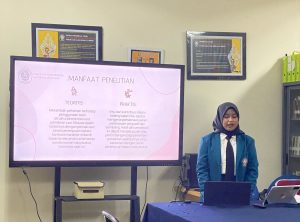
Friday, April 23, 2025 – Shochifah Diyah Puspitasari, a Master’s Program student, successfully held her thesis defense today in the examination room of the Faculty of Literature. Her thesis, titled “Srikandi and the Orientation of Women’s Roles: A Structuralist Analysis of the Srikandi Character Construction in Two Versions”, presents an in-depth study of women’s representation in literature rooted in local and classical cultural traditions.
The thesis was supervised by Dr. Ken Widyatwati, M.Hum., who also served as the head examiner, along with two other examiners: Dr. Sukarjo Waluyo, M.Hum., and Dr. Sukarni Suryaningsih, M.Hum.
This research highlights how the character Srikandi serves as a symbol of the dialectics of women’s roles in society. Shochifah analyzed two versions of the Srikandi story—Srikandi in the Mahabharata and Srikandi, the Mighty Female Warrior—using Claude Lévi-Strauss’s structuralist approach and the sociology of literature theory.
In her presentation, Shochifah explained that each version of the story possesses a distinct narrative structure with unique episodes—seven in the Mahabharata version and nine in the contemporary version. Through a comparison of mythemes, three main pairs of binary oppositions were identified: male >< female, weak >< strong, and restrained >< free.
“These three binary oppositions reveal two primary roles embedded in the character of Srikandi—namely the domestic role and the public role of women,” Shochifah explained during her presentation.
Furthermore, from the perspective of the sociology of literature, the thesis shows that the construction of the Srikandi character directly reflects the current social conditions of women in Indonesia—particularly in the areas of economy, political leadership, and education.
“From this analysis, we can see two orientations of women’s roles inherent in the character of Srikandi: the domestic role and the public role,” Shochifah elaborated.
This study not only explores how the character of Srikandi is shaped within literary texts but also links these findings to the current social realities in Indonesia. Shochifah concludes that the orientation of women’s roles as reflected in Srikandi’s character remains relevant to contemporary issues such as women’s participation in economic sectors, political leadership, and the field of education.
Through this research, Shochifah hopes to contribute to women’s studies in literature and to open broader discussions about the representation and reality of women’s roles in modern society.
The examining committee expressed their appreciation for the sharpness of her analysis and the thematic relevance of the thesis to contemporary issues. Shochifah’s research was deemed a significant contribution to gender studies in literature and enriches the interpretation of wayang characters in a modern context.